
Spectral Fuel Analysis in Seconds
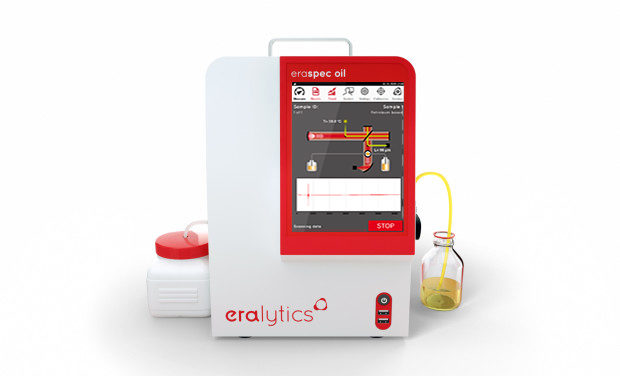
ERASPEC is eralytics’ industry-proven multi-fuel analyzer with several thousand installations worldwide. It offers measurements of fuel component concentrations, complex properties like RON or cetane number, and density for gasoline, diesel fuel, jet fuel and even specialized fuels like ethanol fuels. A single push of a button delivers all results within 1 minute.
Standards
- ASTM D5845
- ASTM D6277
- ASTM D7777
- ASTM D4052
- ISO 12185
- ASTM D7806
- E1655
- EN 238
- EN 14078
- ISO 15212
- IP559
- ASTM D8321
Correlation to
-
- ASTM D86
-
- ASTM D613
- ASTM D976
- ASTM D2699
- ASTM D2700
- ASTM D3948
- ASTM D4814
- ASTM D5769
- ASTM D4815
- ASTM D7371
- ASTM D1322
- ASTM D1319
- ASTM D1840
- ISO 5163
- ISO 5164
- ISO 5165
- EN 13016-1
- EN 13016-2
- ISO 3405
FTIR Fuel Analysis
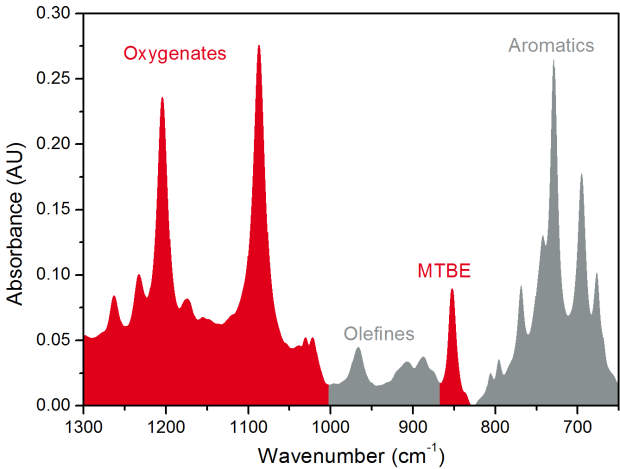
In FTIR fuel analysis a spectrum of the analyzed fuel is recorded in the mid-infrared region using an Fourier transform spectrometer. Depending on the chosen method a single measurement is able to detect over 40 parameters within a few seconds. For gasoline measurements e.g. RON, MON, AKI, distillation properties, esters and aromatics concentrations are determined. When analyzing diesel aromatics, cetane improvers, biodiesel and many more can be quantified. Analyzing biodiesel ERASPEC distinguishes between FAME / FAEE and vegetable oil. It measures FAME in full compliance with ASTM D7806 and EN 14078. Typical parameters for jet fuel include FAME, aromatics, freezing and flash point, smoke point and distillation parameter, as well as viscosity.
Integrated ASTM D4052 Density Measurement
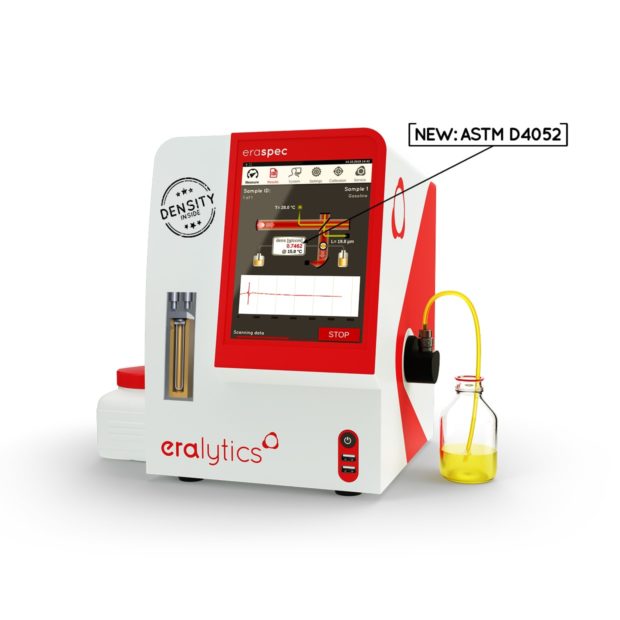
ERASPEC is again expanding the horizon of portable fuel testing with eralytics’ integrated state-of the-art temperature-controlled U-tube density meter modules DENS7777 and DENS4052. In combination with the ultra-light density meter module DENS4052 (patent pending), offering density measurements in full compliance with ASTM D4052 & ISO 12185 (r = 0.0001 g/cm3), ERASPEC can measure density, benzene and FAME in full compliance with international fuel specifications, like ASTM D4814, EN228 and EN590. In its standard version ERASPEC is now equipped with eralytics new DENS7777 U-tube density module that is also temperature-controlled and measures in full compliance with ASTM D7777 & ISO 15212 (r = 0.0005 g/cm3).
Concentrations vs. Parameters
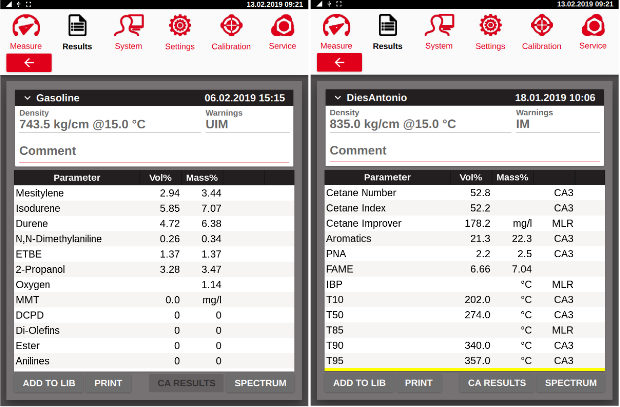
ERASPEC can directly derive fuel component concentrations from the measured IR spectrum. That includes aromatics such as benzene (ASTM D6277), oxygenates such as MTBE or ethanol (ASTM D5845) and octane boosters such as MMT for the measurements of gasoline. Knowing the exact fuel composition, however, also allows to calculate more complex fuel parameters. ERASPEC uses chemometrical models, based on fuel libraries, to calculate parameters such as RON, MON or distillation and evaporation fractions from the spectrum for gasoline. It covers cetane number and index and many more for diesel fuel.
Expandable Database
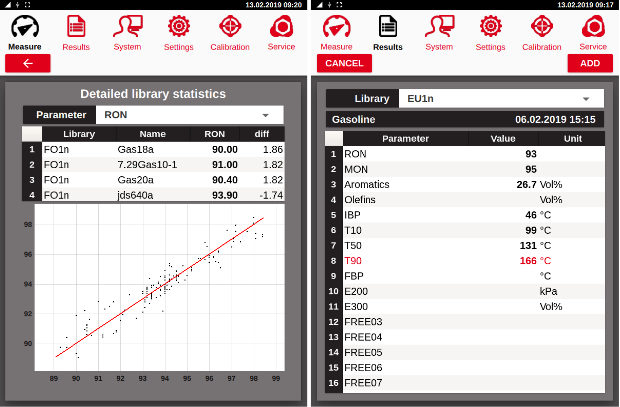
Based on several thousand ERASPEC installations around the world eralytics can rely on a huge experience offering tailor-made databases of international fuel calibration samples with known parameters. Adding customer samples to the databases is as easy as running a measurement and entering the corresponding reference values afterwards. The added data is immediately available for the next measurement as the chemometrical models are calculated on the fly. Next to the expandable database ERASPECs’ intuitive software allows for the easy creation of various library sets and a convenient switch between them. Additionally the exchange of libraries between several ERASPEC instruments is very easy and can be done directly without the need of a PC.
Unknown or Contaminated Samples
The “Automatic Fuel Recognition” (AFR) Module allows an easy measurement of unknown samples with the ERASPEC fuel analyzer. It recognizes if gasoline, diesel or jet fuel is measured and automatically starts the correct analysis according to the registered fuel type.
Most common contaminations of gasoline can be measured with the “Gasoline Contamination Module”. Typical substances that can be quantified are DMM, N-Methyl-Aniline, Diolefines, Aniline, DMC, various Butyl-Acetates and more.
This makes the ERASPEC fuel analyzer to a reliable tool to fight fuel adulteration fraud directly at the gas stations.
Patented Design
The heart of the ERASPEC fuel analyzer is a patented corner-cube retro-reflector FTIR spectrometer. For highest precision it is laser and temperature controlled and its spectral resolution is tailored to the task of fuel analysis. This reduces any noise to an absolute minimum, increasing the repeatability and lowering the possible limits of detection. ERASPECS’ unique triple cell design is now the standard for all analyzers making future instrument upgrades extremely easy. ERASPEC automatically selects between a 20 µm and a 100 µm path length measurement cell depending on the fuel analyzed. This allows ERASPEC to always deliver the best measurement result. A third cell is used to run background measurements if needed. For special applications (e.g. advanced cetane improver determination or FAME determination) a unique fourfold-cell design with wider path-length is available.

Option: 10-position autosampler for high sample throughput
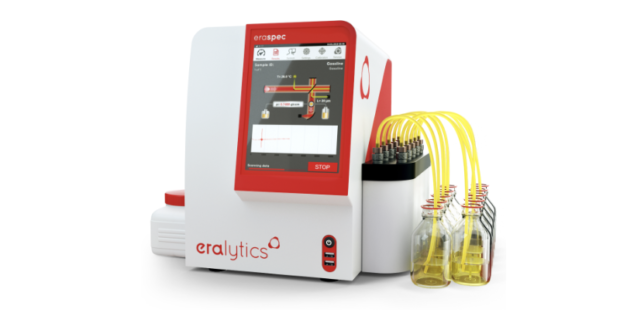
eralytics’ 10-position autosampler is an optional accessory for the spectral fuel analyzer ERASPEC. The 10-position autosampler is directly attached to the instrument allowing it to conveniently connect up to 10 samples simultaneously. It is the perfect solution for higher sample throughput and even more efficiency. All instruments maintain their portability, even with the 10-position autosampler attached. Read more >>
Measurement Procedure
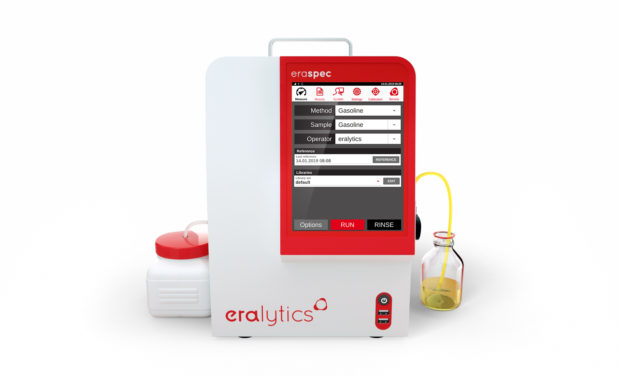
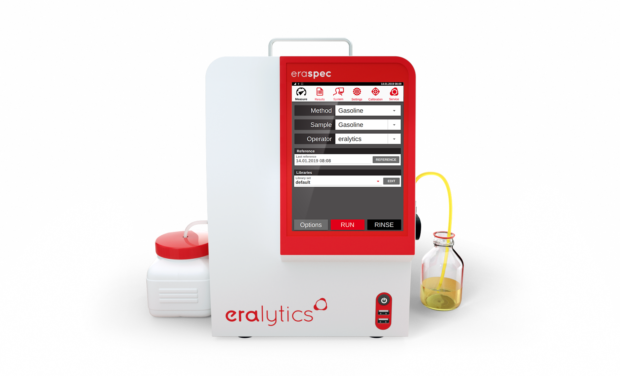
To perform spectral analysis with the ERASPEC fuel analyzer can be done in 4 simple steps:
- Enter sample ID and operator name
- Select the measurement standard and the library to be used for calculating properties
- Put your sample next to the fuel analyzer and insert the inlet tube
- Press the RUN button
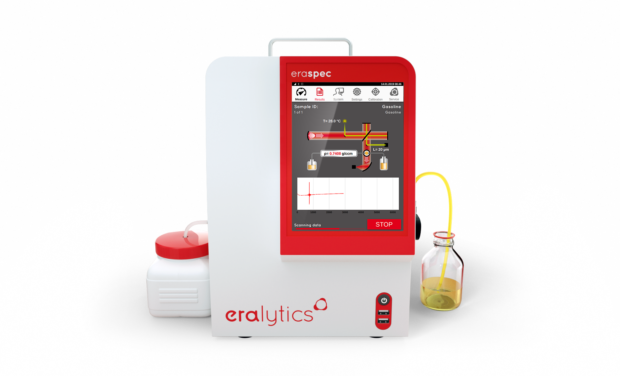
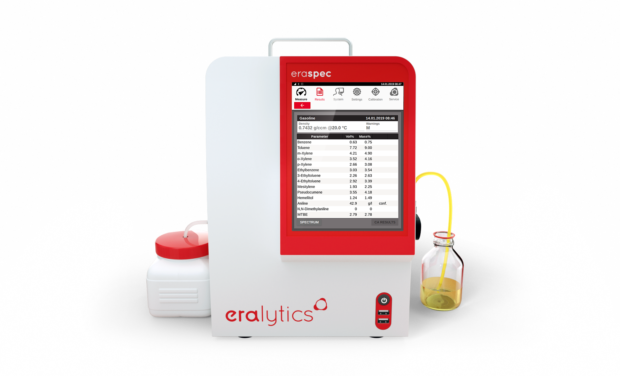
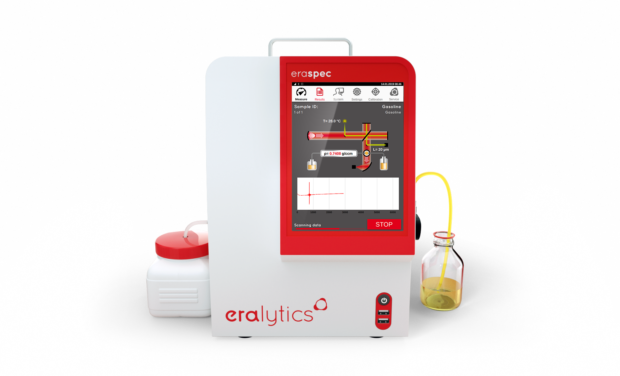
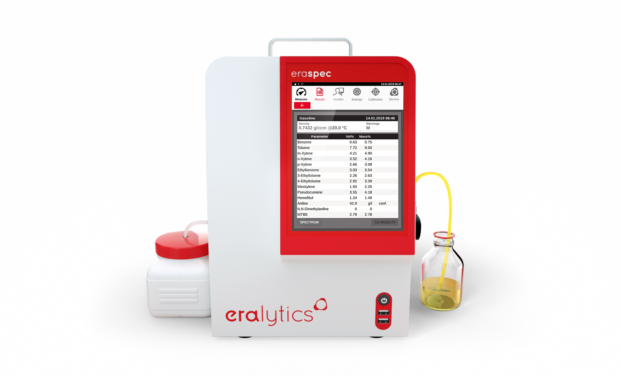
The measurement steps are visualized on the display, showing the deflection of the moving mirror of the interferometer. When the measurement is completed the results are displayed and can be printed or added to a library with a single click. When adding the results of the fuel analyzer to a library an editor for entering known properties will appear. This will improve the quality of future measurements using the ERASPEC fuel analyzer, as the library can be tailored to a specific application.
Parameters Gasoline Module
| Properties1 | Range |
|---|---|
| Research Octane Number (RON) | 70 – 110 |
| Motor Octane Number (MON) | 60 – 100 |
| Anti Knock Index (AKI) | 65 – 105 |
| RVP & DVPE | 35 – 105 kPa |
| Distillation fractions | IBP, T10, T50, T90, FBP |
| Evaporation fractions | E70, E100, E150, E180, E200, E300, E350, E370 |
| Density (built-in U-tube cell) | 0 – 3 gcm-3 |
| Driveability Index, VOC Emissions Calculator, Vapor Lock Index (VLI), User Definable Parameters | |
| Sum Parameters | Range |
|---|---|
| Aromatics1 | 0 – 80 Vol% |
| Olefins1 | 0 – 80 Vol% |
| Di-Olefins2 | 0 – 20 Vol% |
| Oxygenates2 | 0 – 80 Vol% |
| Oxygen2 | 0 – 12 wt% |
| Anilines2 | 0 – 25 Vol% |
| Esters2 | 0 – 30 Vol% |
| Saturates | 0 – 100 Vol% |
| Oxygenate Parameters2 | Range |
|---|---|
| MTBE | 0 – 20 Vol% |
| ETBE | 0 – 25 Vol% |
| TAME | 0 – 25 Vol% |
| TAEE | 0 – 20 Vol% |
| DIPE | 0 – 20 Vol% |
| Dimethoxymethane (DMM) | 0 – 20 Vol% |
| Methanol | 0 – 15 Vol% |
| Ethanol | 0 – 100 Vol% |
| Iso-Propanol | 0 – 20 Vol% |
| 1-Butanol | 0 – 100 Vol% |
| 2-Butanol | 0 – 25 Vol% |
| Isobutanol | 0 – 50 Vol% |
| tert-Butanol | 0 – 25 Vol% |
| tert-Amylalcohol | 0-20 Vol% |
| Dimethylcarbonate (DMC) | 0 – 15 Vol% |
| Methylacetate | 0 – 15 Vol% |
| Ethylacetate | 0 – 15 Vol% |
| Isobutylacetate | 0 – 15 Vol% |
| Sec-Butylacetate | 0 – 15 Vol% |
| Nitromethane | 0 – 9 m% |
| Aromatics2 | Range |
|---|---|
| Benzene | 0 -10 Vol% |
| Toluene | 0 – 20 Vol% |
| o-Xylene | 0 – 20 Vol% |
| m-Xylene | 0 – 20 Vol% |
| p-Xylene | 0 – 20 Vol% |
| Ethylbenzene | 0 – 20 Vol% |
| Propylbenzene | 0 – 20 Vol% |
| 2-Ethyltoluene | 0 – 20 Vol% |
| 3-Ethyltoluene | 0 – 20 Vol% |
| 4-Ethyltoluene | 0 – 20 Vol% |
| Pseudocumene | 0 – 20 Vol% |
| Hemillitol | 0 – 20 Vol% |
| Mesitylene | 0 – 20 Vol% |
| Iso-Durene | 0 – 20 Vol% |
| Durene | 0 – 20 Vol% |
| Naphthalene | 0 – 10 Vol% |
| Octane Boosters2 | Range |
|---|---|
| MMT | 0 – 10000 mg/L |
| Manganese | 0 – 2 500 mg/L |
| DCPD (Dicyclopentadiene) | 0 – 15 Vol% |
| Cyclohexane | 0 – 100 Vol% |
| Nitromethane | 0 – 10 Vol% |
| Anilines2 | Range |
|---|---|
| Aniline | 0 – 15 Vol% |
| N-Methylaniline | 0 – 15 Vol% |
| o-Methoxyaniline | 0 – 20 Vol% |
| o-Toluidine | 0 – 20 Vol% |
| m-Toluidine | 0 – 20 Vol% |
| p-Toluidine | 0 – 20 Vol% |
| N,N, Dimethylaniline | 0 – 20 Vol% |
Easy addition of unlimited user-defined properties.
1 … The range and repeatability for all correlated properties depend on the used database.
2 … Lowest concentrations correspond to the limit of detection (LOD), all concentrations in Vol% and wt%
Parameters Diesel Module
| Properties1 | Range |
|---|---|
| Cetane Number | 20 – 80 |
| Cetane Index | 20 – 80 |
| Distillation fractions | IBP, T10, T50, T65, T85, T90, T95, FBP |
| Evaporation fractions | E250, E350 |
| CFPP | -50 – +20 °C |
| Viscosity @ 40 °C | 0 – 10 mm2/s |
| Density (built-in U-tube cell) | 0 – 3 gcm-3 |
Easy addition of unlimited user-defined properties.
1 … The range and repeatability for all correlated properties depend on the used database.
2 … Lowest concentrations correspond to the limit of detection (LOD), all concentrations in Vol% and wt%.
| Parameters | Range |
|---|---|
| Total Aromatics1 | 0 – 80 Vol% |
| Polynuclear Aromatics (PNA)1 | 0 – 80 Vol% |
| Benzene2 | 0 – 5 Vol% |
| Cetane Improver (2-EHN, IPN)2 | 0 – 20 000 mg/L |
| Dimethoxymethane (Methylal)2 | 0 – 20 Vol% |
| FAME2 | 0 – 100 Vol% |
| FAEE2 | 0 – 100 Vol% |
| Vegetable Oil2 | 0 – 65 Vol% |
| Distinction between FAME (Biodiesel) and vegetable oil | |
| Separate calibrations for different FAME / FAEE sources | |
Parameters Jet Fuel Module
| Properties1 | Range |
|---|---|
| Freezing Point | -80 – -20 °C |
| Flash Point | -20 – +100 °C |
| Smoke Point | 0 – 1000 mm |
| Viscosity at 20°C | 1.2 – 2.1 mPas |
| Viscosity at -20°C | 0 – 10 mPas |
| Distillation fractions | IBP, T10, T50, T65, T85, T90, T95, FBP |
| MSEP | 50 – 100 % |
| Density (built-in U-tube cell) | 0 – 3 gcm-3 |
| Parameters | Range |
|---|---|
| Total Aromatics1 | 0 – 80 Vol% |
| FAME concentration2 | 0 – 6 Vol% |
| Polynuclear Aromatics (PNA)1 | 0 – 10 Vol% |
Easy addition of unlimited user-defined properties.
1 … The range and repeatability for all correlated properties depend on the used database.
2 … Lowest concentrations correspond to the limit of detection (LOD), all concentrations in Vol% and wt%
Parameters Fuel Ethanol & Fuel Methanol Modules
Fuel Ethanol Module
| Parameter2 | Range |
|---|---|
| Ethanol | 0 – 100 Vol% |
| Water | 0 – 100 Vol% |
| Methanol | 0 – 15 Vol% |
| Denaturant | 0 – 100 Vol% |
| Density (built-in U-tube cell) | 0 – 3 gcm-3 |
Fuel Methanol Module
| Parameter2 | Range |
|---|---|
| Methanol | 0 – 100 Vol% |
| Density (built-in U-tube cell) | 0 – 3 gcm-3 |
Easy addition of unlimited user-defined properties.
2 … Lowest concentrations correspond to the limit of detection (LOD), all concentrations in Vol% and wt%
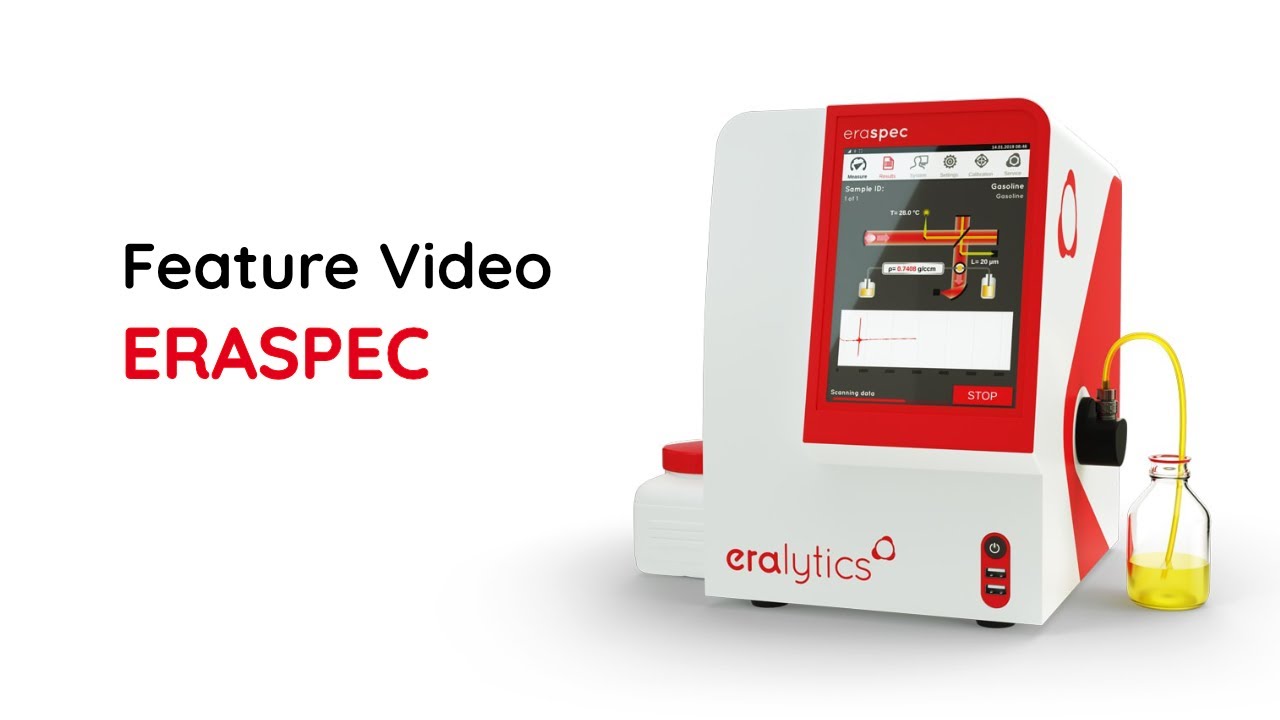
ERASPEC Feature Video
- Characterization of over 40 fuel parameters within 60 seconds
- Patented rugged FTIR and laser / temperature design for highest precision
- Factory calibrated with a matrix of several hundred international fuels
- Easy expandable libraries to tailor the reference matrix to special applications
- Tailored path-lengths for various applications
- Built-in oscillation U-tube density meter (ISO 15212)
- Comprehensive fuel analysis of gasoline, diesel fuel and jet fuel in seconds
- Biodiesel (ASTM D7806) and vegetable oil detection in diesel fuel
By loading the video, you agree to YouTube’s privacy policy.
Learn more
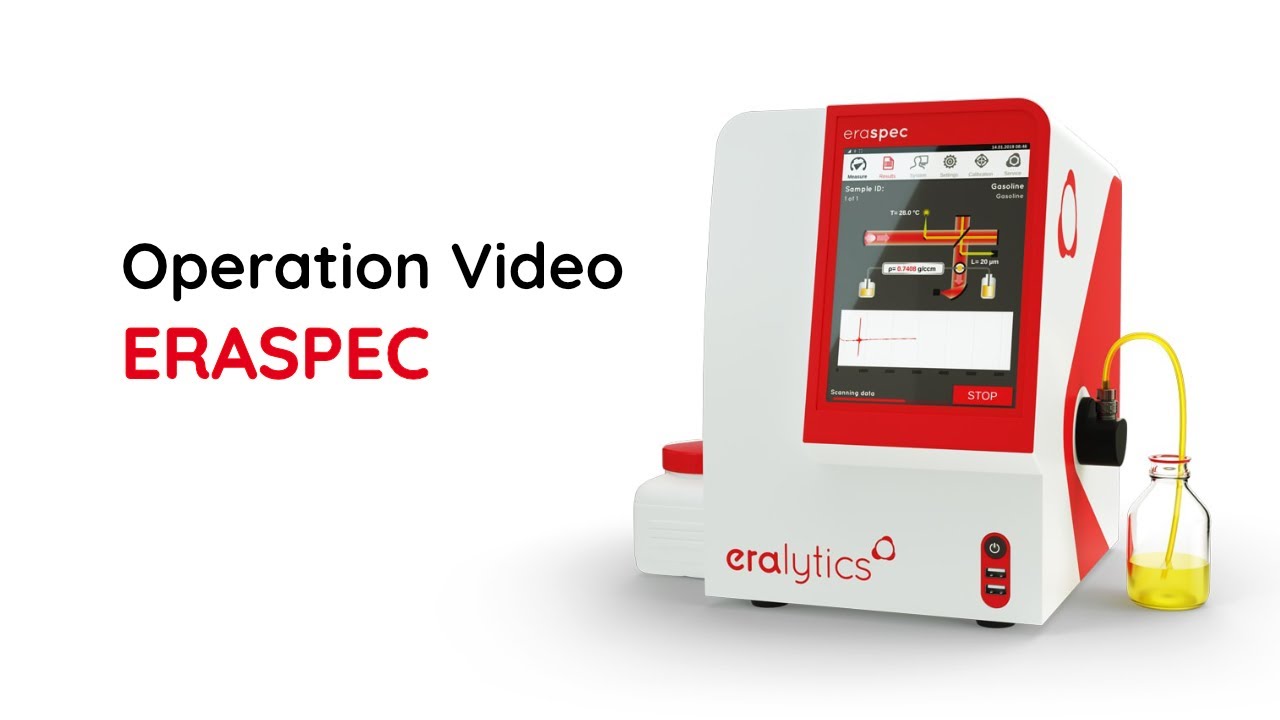
ERASPEC Operation Video
Watch this video to get an overview of the standard operation of ERASPEC: From installation to measurement and some extended measuring options.
By loading the video, you agree to YouTube’s privacy policy.
Learn more
FTIR Fuel Analysis
In FTIR fuel analysis a spectrum of the analyzed fuel is recorded in the mid-infrared region using an Fourier transform spectrometer. Depending on the chosen method a single measurement is able to detect over 40 parameters within a few seconds. For gasoline measurements e.g. RON, MON, AKI, distillation properties, esters and aromatics concentrations are determined. When analyzing diesel aromatics, cetane improvers, biodiesel and many more can be quantified. Analyzing biodiesel ERASPEC distinguishes between FAME / FAEE and vegetable oil. It measures FAME in full compliance with ASTM D7806 and EN 14078. Typical parameters for jet fuel include FAME, aromatics, freezing and flash point, smoke point and distillation parameter, as well as viscosity.
FTIR Fuel Analysis
In FTIR fuel analysis a spectrum of the analyzed fuel is recorded in the mid-infrared region using an Fourier transform spectrometer. Depending on the chosen method a single measurement is able to detect over 40 parameters within a few seconds. For gasoline measurements e.g. RON, MON, AKI, distillation properties, esters and aromatics concentrations are determined. When analyzing diesel aromatics, cetane improvers, biodiesel and many more can be quantified. Analyzing biodiesel ERASPEC distinguishes between FAME / FAEE and vegetable oil. It measures FAME in full compliance with ASTM D7806 and EN 14078. Typical parameters for jet fuel include FAME, aromatics, freezing and flash point, smoke point and distillation parameter, as well as viscosity.
Integrated ASTM D4052 Density Measurement
ERASPEC is again expanding the horizon of portable fuel testing with eralytics’ integrated state-of the-art temperature-controlled U-tube density meter modules DENS7777 and DENS4052. In combination with the ultra-light density meter module DENS4052 (patent pending), offering density measurements in full compliance with ASTM D4052 & ISO 12185 (r = 0.0001 g/cm3), ERASPEC can measure density, benzene and FAME in full compliance with international fuel specifications, like ASTM D4814, EN228 and EN590. In its standard version ERASPEC is now equipped with eralytics new DENS7777 U-tube density module that is also temperature-controlled and measures in full compliance with ASTM D7777 & ISO 15212 (r = 0.0005 g/cm3).
Integrated ASTM D4052 Density Measurement
ERASPEC is again expanding the horizon of portable fuel testing with eralytics’ integrated state-of the-art temperature-controlled U-tube density meter modules DENS7777 and DENS4052. In combination with the ultra-light density meter module DENS4052 (patent pending), offering density measurements in full compliance with ASTM D4052 & ISO 12185 (r = 0.0001 g/cm3), ERASPEC can measure density, benzene and FAME in full compliance with international fuel specifications, like ASTM D4814, EN228 and EN590. In its standard version ERASPEC is now equipped with eralytics new DENS7777 U-tube density module that is also temperature-controlled and measures in full compliance with ASTM D7777 & ISO 15212 (r = 0.0005 g/cm3).
Concentrations vs. Parameters
ERASPEC can directly derive fuel component concentrations from the measured IR spectrum. That includes aromatics such as benzene (ASTM D6277), oxygenates such as MTBE or ethanol (ASTM D5845) and octane boosters such as MMT for the measurements of gasoline. Knowing the exact fuel composition, however, also allows to calculate more complex fuel parameters. ERASPEC uses chemometrical models, based on fuel libraries, to calculate parameters such as RON, MON or distillation and evaporation fractions from the spectrum for gasoline. It covers cetane number and index and many more for diesel fuel.
Concentrations vs. Parameters
ERASPEC can directly derive fuel component concentrations from the measured IR spectrum. That includes aromatics such as benzene (ASTM D6277), oxygenates such as MTBE or ethanol (ASTM D5845) and octane boosters such as MMT for the measurements of gasoline. Knowing the exact fuel composition, however, also allows to calculate more complex fuel parameters. ERASPEC uses chemometrical models, based on fuel libraries, to calculate parameters such as RON, MON or distillation and evaporation fractions from the spectrum for gasoline. It covers cetane number and index and many more for diesel fuel.
Expandable Database
Based on several thousand ERASPEC installations around the world eralytics can rely on a huge experience offering tailor-made databases of international fuel calibration samples with known parameters. Adding customer samples to the databases is as easy as running a measurement and entering the corresponding reference values afterwards. The added data is immediately available for the next measurement as the chemometrical models are calculated on the fly. Next to the expandable database ERASPECs’ intuitive software allows for the easy creation of various library sets and a convenient switch between them. Additionally the exchange of libraries between several ERASPEC instruments is very easy and can be done directly without the need of a PC.
Expandable Database
Based on several thousand ERASPEC installations around the world eralytics can rely on a huge experience offering tailor-made databases of international fuel calibration samples with known parameters. Adding customer samples to the databases is as easy as running a measurement and entering the corresponding reference values afterwards. The added data is immediately available for the next measurement as the chemometrical models are calculated on the fly. Next to the expandable database ERASPECs’ intuitive software allows for the easy creation of various library sets and a convenient switch between them. Additionally the exchange of libraries between several ERASPEC instruments is very easy and can be done directly without the need of a PC.
Unknown or Contaminated Samples
The “Automatic Fuel Recognition” (AFR) Module allows an easy measurement of unknown samples with the ERASPEC fuel analyzer. It recognizes if gasoline, diesel or jet fuel is measured and automatically starts the correct analysis according to the registered fuel type.
Most common contaminations of gasoline can be measured with the “Gasoline Contamination Module”. Typical substances that can be quantified are DMM, N-Methyl-Aniline, Diolefines, Aniline, DMC, various Butyl-Acetates and more.
This makes the ERASPEC fuel analyzer to a reliable tool to fight fuel adulteration fraud directly at the gas stations.
Unknown or Contaminated Samples
The “Automatic Fuel Recognition” (AFR) Module allows an easy measurement of unknown samples with the ERASPEC fuel analyzer. It recognizes if gasoline, diesel or jet fuel is measured and automatically starts the correct analysis according to the registered fuel type.
Most common contaminations of gasoline can be measured with the “Gasoline Contamination Module”. Typical substances that can be quantified are DMM, N-Methyl-Aniline, Diolefines, Aniline, DMC, various Butyl-Acetates and more.
This makes the ERASPEC fuel analyzer to a reliable tool to fight fuel adulteration fraud directly at the gas stations.
Patented Design
The heart of the ERASPEC fuel analyzer is a patented corner-cube retro-reflector FTIR spectrometer. For highest precision it is laser and temperature controlled and its spectral resolution is tailored to the task of fuel analysis. This reduces any noise to an absolute minimum, increasing the repeatability and lowering the possible limits of detection. ERASPECS’ unique triple cell design is now the standard for all analyzers making future instrument upgrades extremely easy. ERASPEC automatically selects between a 20 µm and a 100 µm path length measurement cell depending on the fuel analyzed. This allows ERASPEC to always deliver the best measurement result. A third cell is used to run background measurements if needed. For special applications (e.g. advanced cetane improver determination or FAME determination) a unique fourfold-cell design with wider path-length is available.
Patented Design
The heart of the ERASPEC fuel analyzer is a patented corner-cube retro-reflector FTIR spectrometer. For highest precision it is laser and temperature controlled and its spectral resolution is tailored to the task of fuel analysis. This reduces any noise to an absolute minimum, increasing the repeatability and lowering the possible limits of detection. ERASPECS’ unique triple cell design is now the standard for all analyzers making future instrument upgrades extremely easy. ERASPEC automatically selects between a 20 µm and a 100 µm path length measurement cell depending on the fuel analyzed. This allows ERASPEC to always deliver the best measurement result. A third cell is used to run background measurements if needed. For special applications (e.g. advanced cetane improver determination or FAME determination) a unique fourfold-cell design with wider path-length is available.
Option: 10-position autosampler for high sample throughput
eralytics’ 10-position autosampler is an optional accessory for the spectral fuel analyzer ERASPEC. The 10-position autosampler is directly attached to the instrument allowing it to conveniently connect up to 10 samples simultaneously. It is the perfect solution for higher sample throughput and even more efficiency. All instruments maintain their portability, even with the 10-position autosampler attached. Read more >>
Option: 10-position autosampler for high sample throughput
eralytics’ 10-position autosampler is an optional accessory for the spectral fuel analyzer ERASPEC. The 10-position autosampler is directly attached to the instrument allowing it to conveniently connect up to 10 samples simultaneously. It is the perfect solution for higher sample throughput and even more efficiency. All instruments maintain their portability, even with the 10-position autosampler attached. Read more >>
Measurement Procedure
To perform spectral analysis with the ERASPEC fuel analyzer can be done in 4 simple steps:
- Enter sample ID and operator name
- Select the measurement standard and the library to be used for calculating properties
- Put your sample next to the fuel analyzer and insert the inlet tube
- Press the RUN button
The measurement steps are visualized on the display, showing the deflection of the moving mirror of the interferometer. When the measurement is completed the results are displayed and can be printed or added to a library with a single click. When adding the results of the fuel analyzer to a library an editor for entering known properties will appear. This will improve the quality of future measurements using the ERASPEC fuel analyzer, as the library can be tailored to a specific application.
Measurement Procedure
To perform spectral analysis with the ERASPEC fuel analyzer can be done in 4 simple steps:
- Enter sample ID and operator name
- Select the measurement standard and the library to be used for calculating properties
- Put your sample next to the fuel analyzer and insert the inlet tube
- Press the RUN button
The measurement steps are visualized on the display, showing the deflection of the moving mirror of the interferometer. When the measurement is completed the resu