Standards
ASTM D5188ASTM D5191ASTM D6377ASTM D6378
- ASTM D6897
- EN 13016-1
- EN 13016-2
- EN 13016-3
- IP394
- IP409
- IP481
- JIS K2258-2
- SHT 0769
- SHT 0794
- SN/T 2932
- GOST 52340
Correlation to
- ASTM D1267
- ASTM D2533
- ASTM D2879
- ASTM D4953
- ASTM D5190
- ASTM D5482
Crude Oil Vapor Pressure Testing
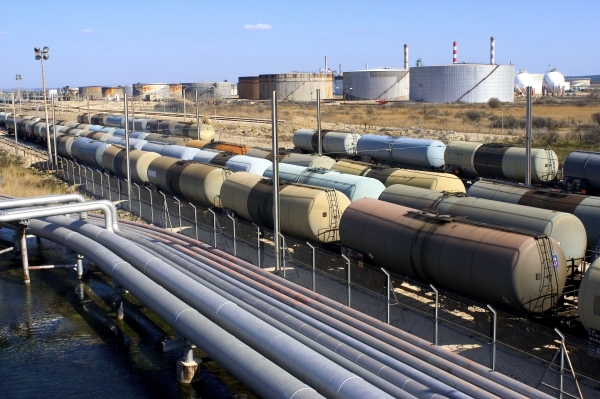
Vapor pressure of crude oil is a key parameter when planning the transportation of crudes through different climate zones. When performing crude oil vapor pressure measurements one has to bear the actual ambient conditions during transportation in mind. Is the crude transported in rail cars the headspace is approximately 5% where as a floating roof-top tank has nearly no headspace at all. This is important since the vapor to liquid ratio (V/L) and the storage temperature are highly influencing the vapor pressure of crude. This is especially true for live crude oil which still contains high amounts of volatile light ends.
2-in-1: Vapor Pressure and Density
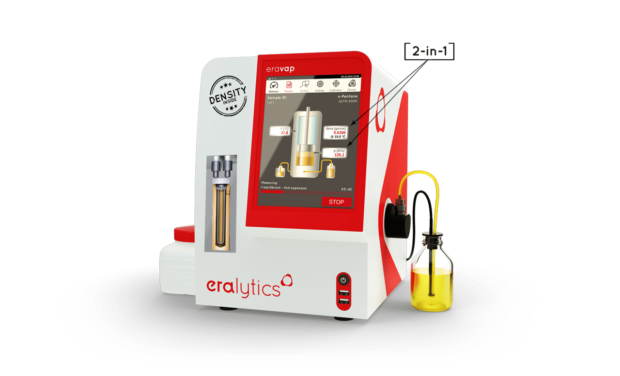
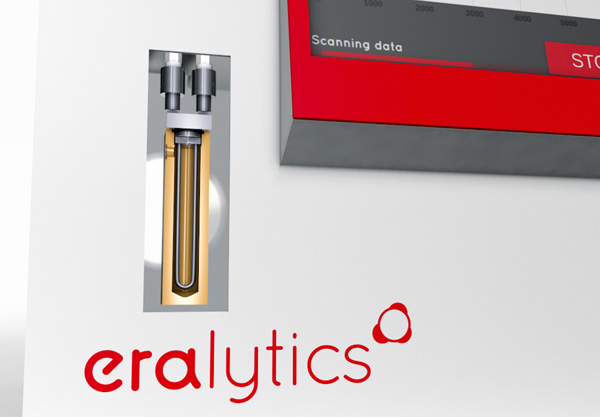
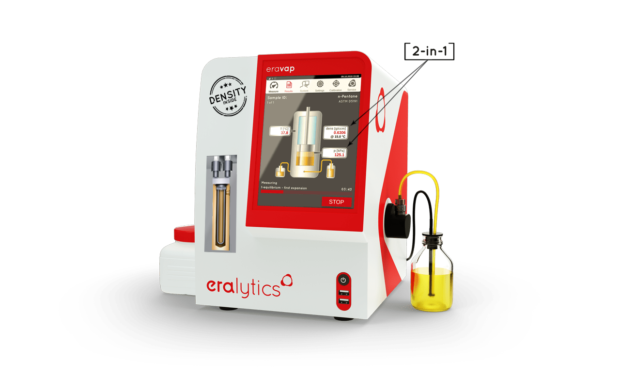
ERAVAP is the only vapor pressure tester on the market that can be equipped with the optional density meter module DENS4052, fully compliant to ASTM D4052 & ISO 12185 (r = 0.0001 g/cm³). This allows for a simultaneous density and vapor pressure measurement of crude oil. Additionally, the density module can be combined with a pressurized filling system (FPC/MPC), making it uniquely convenient for the testing of volatile crude oils.
Pressurized Sampling Solutions
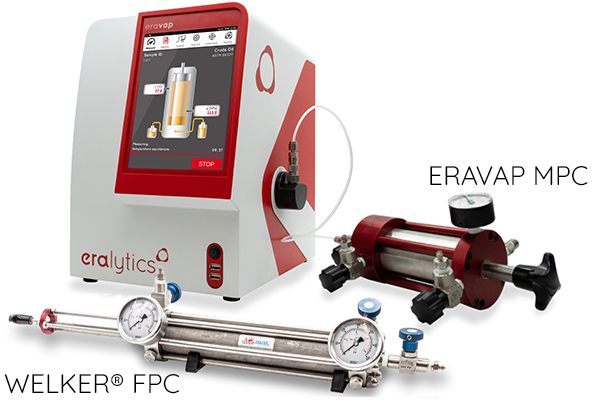
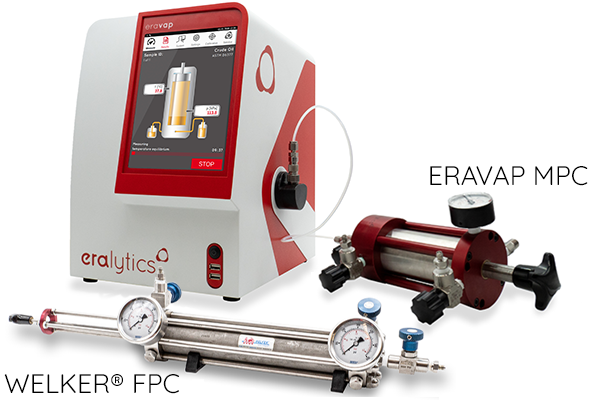
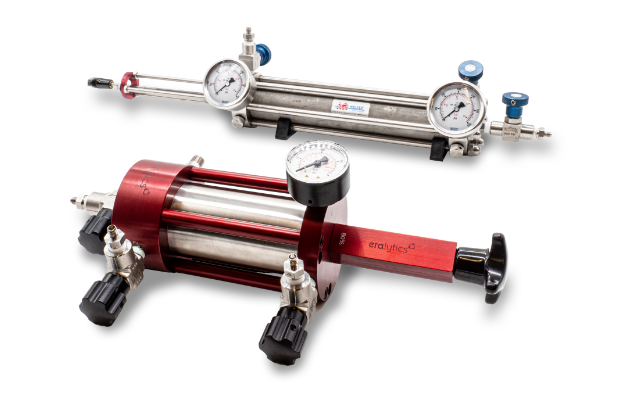
Measuring live crudes containing high amounts of volatiles requires the use of a pressurized sampling system, such as eralytics newly developed manual piston cylinder ERAVAP MPC (ASTM D8009) or standard FPC floating piston cylinders (ASTM D3700). If such crudes are measured from an open bottle, most volatiles will be lost, giving wrong VP results. For highly pressurized sampling eralytics special pressure regulator can be attached directly to ERAVAP.
High Performance Cell Shaking Technology
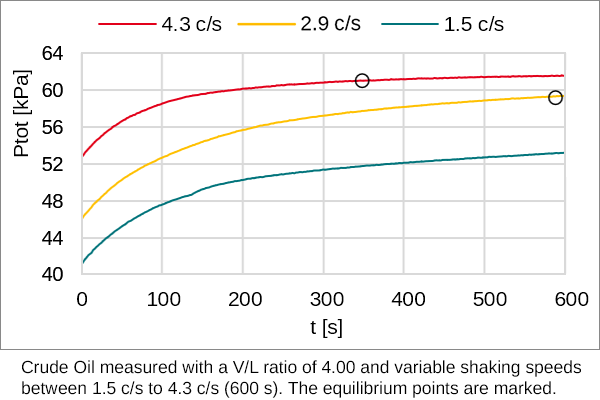
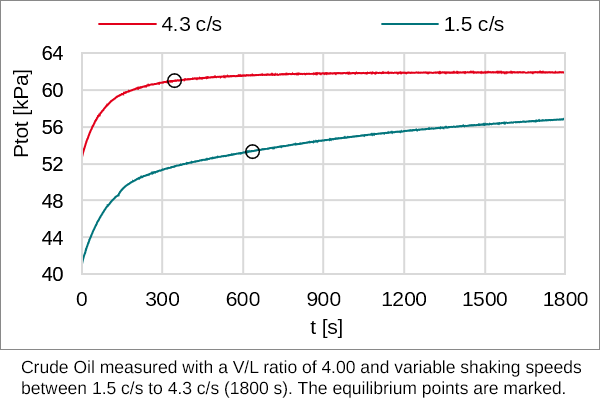
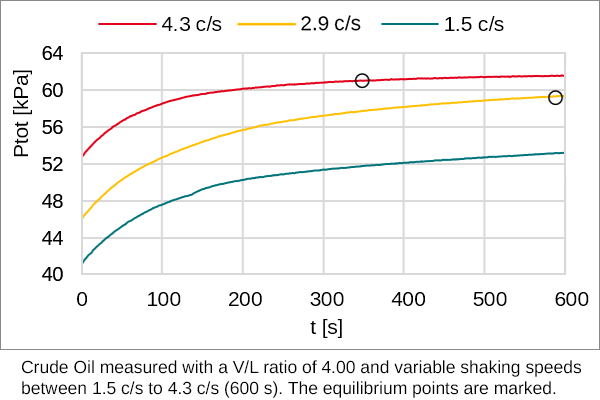
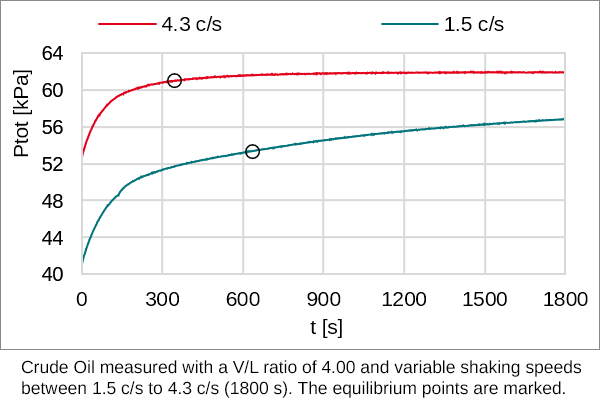
Crude oil properties like viscosity play an important role in vapor pressure measurements. As a higher viscosity significantly delays the formation of a pressure equilibrium, shaking of the measuring cell is mandatory for ASTM D6377. ERAVAP features a superior cell and shaker design, which allows for a shaking speed of 4.3 cycles per second (red curves), much higher compared to other vapor pressure testers on the market (green and yellow curves). This results not only in a faster measurement but also significantly increases the accuracy and precision. Insufficient shaking or applying a static measuring time can lead to lower values with a bias of up to 10 kPa (1.5 psi).
An excellent e-learning presentation on this topic based on the basics of vapor pressure testing and sampling and testing is provided by the CCQTA on their website >>
V/L and Temperature Influences
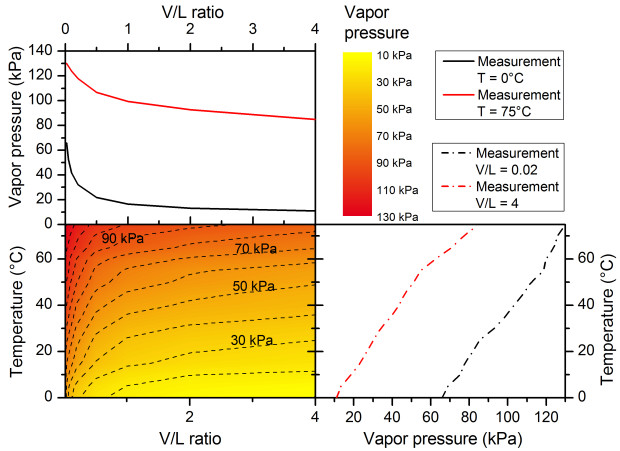
The graph on the side shows the influence of the V/L ratio and the temperature on crude oil vapor pressure testing.
Measuring at the standard conditions of V/L = 4 and T = 37.8 °C the vapor pressure of the sample crude was approximately 40 kPa. At a V/L ratio of 0.02 found in rail cars, trucks or ships already gives a vapor pressure of around 100 kPa. Assuming that this storage tank stands in bright sunlight heating its content to a temperature of 60 °C the vapor pressure rises even further to 120 kPa.
The more light ends the transported crude contains the higher these effects will get. This highlights the importance to measure the crude’s vapor pressure under realistic conditions.
HVM – High Viscosity Module
eralytics‘ high viscosity module also allows the measurement of highly viscous samples. By heating the inlet, the outlet, and all connecting tubes as well as the inlet assembly up to 70 °C, this optional HVM module makes ERAVAP the perfect analyzer for challenging samples like fuel oil or heavy crudes. ERAVAP Crude directly draws up the sample into the measurement chamber by a piston. Sample take-up of more viscous samples naturally takes a longer time until a viscosity where it becomes impractical. Heating up the sample prior to the introduction reduces the viscosity and the filling procedure speeds up.
ERAVAP – Unique Measuring Options
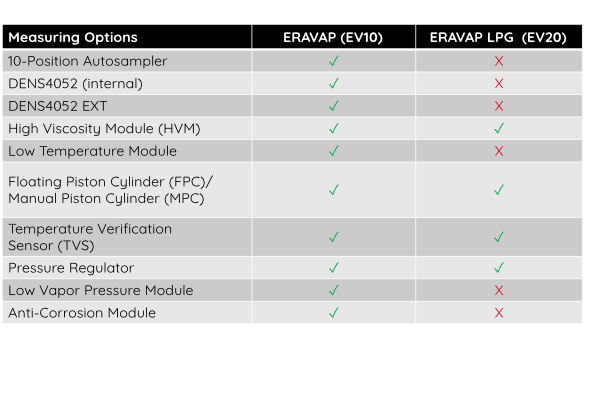
The Vapor Pressure Tester ERAVAP is available in two models. ERAVAP (EV10) for vapor pressure testing of all kinds of liquids up to a max. vapor pressure of 1000 kPa (145 psi) and ERAVAP LPG (EV20) for vapor pressure testing of LPG’s featuring an extended pressure range of up to 2000 kPa (290 psi). To complete your range of applications, eralytics offers a variety of unique measuring options for both ERAVAP models. Get an overview of the unique measuring options of ERAVAP here >>
ASTM D6377 and CCQTA Recommendations
ASTM D6377 allows using a wide range of different parameters for crude oil vapor pressure testing. Thus it can be tailored to fit the parameters for most conditions. Studies by the Canadian Crude Quality Technical Association (CCQTA), however, showed that the thermal expansion of the samples makes measurements at very low V/L ratios difficult. CCQTA prefers to analyze the V/L ratio curves at a specific temperature to judge the crude oil.
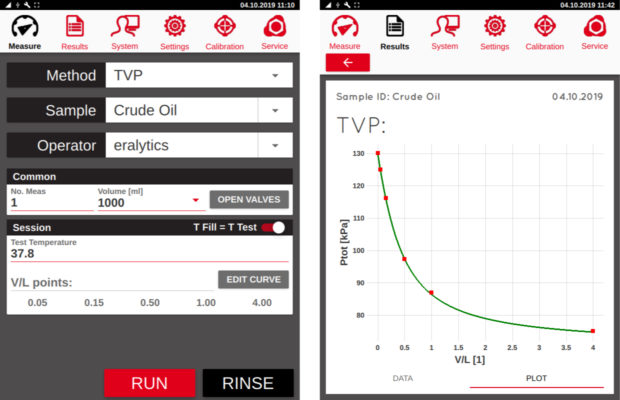
eralytics’ found a solution for the thermal expansion issue in ERAVAP crude and therefore can measure accurate crude oil vapor pressures at V/L = 0.02. Additionally, curve measurement programs at various V/L ratios are available, including the TVP method (True vapor pressure) which calculates the theoretical VPCR at V/L = 0. This makes ERAVAP crude the ideal choice for crude oil measurement applications.
Application Video: ERAVAP – Crude Oil Testing at its Best
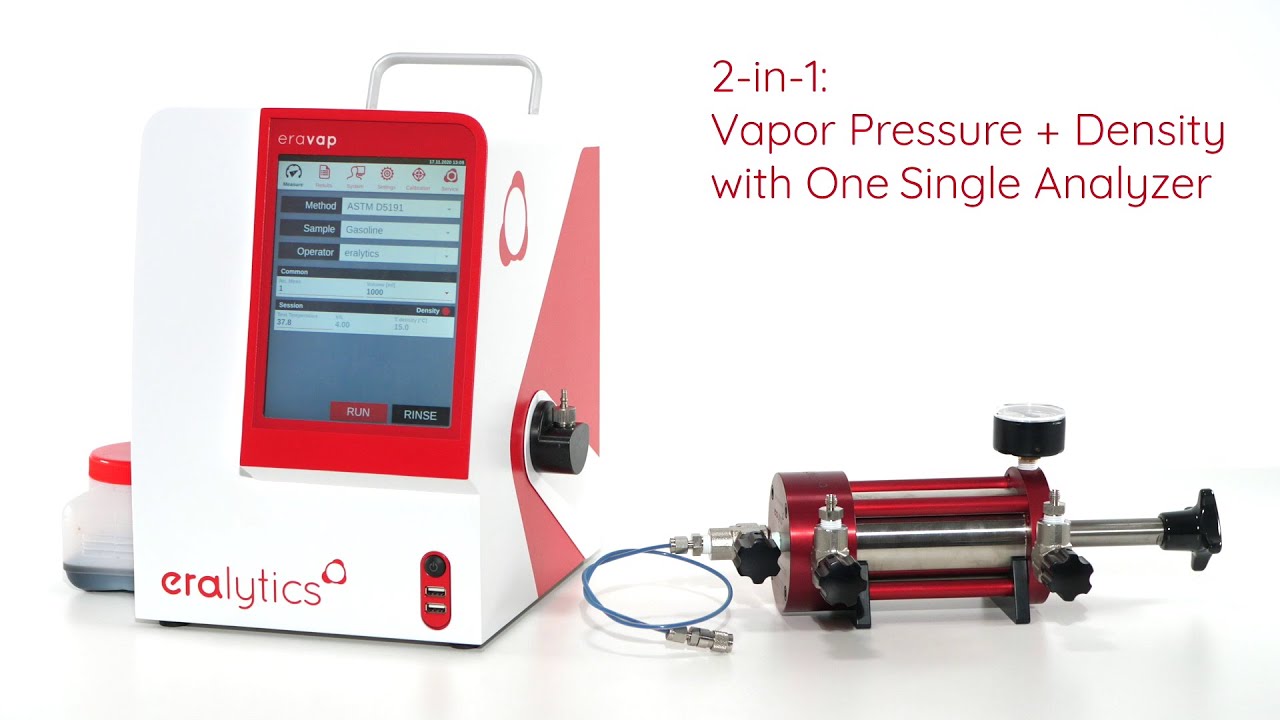
Watch eralytics latest application video and convince yourself how we set the benchmark for Vapor Pressure + Density testing of crude oil combining ERAVAP with eralytics revolutionary density meter module DENS4052 and our new piston-cylinder ERAVAP MPC.
By loading the video, you agree to YouTube’s privacy policy.
Learn more
Crude Oil Vapor Pressure Testing
Vapor pressure of crude oil is a key parameter when planning the transportation of crudes through different climate zones. When performing crude oil vapor pressure measurements one has to bear the actual ambient conditions during transportation in mind. Is the crude transported in rail cars the headspace is approximately 5% where as a floating roof-top tank has nearly no headspace at all. This is important since the vapor to liquid ratio (V/L) and the storage temperature are highly influencing the vapor pressure of crude. This is especially true for live crude oil which still contains high amounts of volatile light ends.
Crude Oil Vapor Pressure Testing
Vapor pressure of crude oil is a key parameter when planning the transportation of crudes through different climate zones. When performing crude oil vapor pressure measurements one has to bear the actual ambient conditions during transportation in mind. Is the crude transported in rail cars the headspace is approximately 5% where as a floating roof-top tank has nearly no headspace at all. This is important since the vapor to liquid ratio (V/L) and the storage temperature are highly influencing the vapor pressure of crude. This is especially true for live crude oil which still contains high amounts of volatile light ends.
2-in-1: Vapor Pressure and Density
ERAVAP is the only vapor pressure tester on the market that can be equipped with the optional density meter module DENS4052, fully compliant to ASTM D4052 & ISO 12185 (r = 0.0001 g/cm³). This allows for a simultaneous density and vapor pressure measurement of crude oil. Additionally, the density module can be combined with a pressurized filling system (FPC/MPC), making it uniquely convenient for the testing of volatile crude oils.
2-in-1: Vapor Pressure and Density
ERAVAP is the only vapor pressure tester on the market that can be equipped with the optional density meter module DENS4052, fully compliant to ASTM D4052 & ISO 12185 (r = 0.0001 g/cm³). This allows for a simultaneous density and vapor pressure measurement of crude oil. Additionally, the density module can be combined with a pressurized filling system (FPC/MPC), making it uniquely convenient for the testing of volatile crude oils.
Pressurized Sampling Solutions
Measuring live crudes containing high amounts of volatiles requires the use of a pressurized sampling system, such as eralytics newly developed manual piston cylinder ERAVAP MPC (ASTM D8009) or standard FPC floating piston cylinders (ASTM D3700). If such crudes are measured from an open bottle, most volatiles will be lost, giving wrong VP results. For highly pressurized sampling eralytics special pressure regulator can be attached directly to ERAVAP.
Pressurized Sampling Solutions
Measuring live crudes containing high amounts of volatiles requires the use of a pressurized sampling system, such as eralytics newly developed manual piston cylinder ERAVAP MPC (ASTM D8009) or standard FPC floating piston cylinders (ASTM D3700). If such crudes are measured from an open bottle, most volatiles will be lost, giving wrong VP results. For highly pressurized sampling eralytics special pressure regulator can be attached directly to ERAVAP.
High Performance Cell Shaking Technology
Crude oil properties like viscosity play an important role in vapor pressure measurements. As a higher viscosity significantly delays the formation of a pressure equilibrium, shaking of the measuring cell is mandatory for ASTM D6377. ERAVAP features a superior cell and shaker design, which allows for a shaking speed of 4.3 cycles per second (red curves), much higher compared to other vapor pressure testers on the market (green and yellow curves). This results not only in a faster measurement but also significantly increases the accuracy and precision. Insufficient shaking or applying a static measuring time can lead to lower values with a bias of up to 10 kPa (1.5 psi).
An excellent e-learning presentation on this topic based on the basics of vapor pressure testing and sampling and testing is provided by the CCQTA on their website >>
High Performance Cell Shaking Technology
Crude oil properties like viscosity play an important role in vapor pressure measurements. As a higher viscosity significantly delays the formation of a pressure equilibrium, shaking of the measuring cell is mandatory for ASTM D6377. ERAVAP features a superior cell and shaker design, which allows for a shaking speed of 4.3 cycles per second (red curves), much higher compared to other vapor pressure testers on the market (green and yellow curves). This results not only in a faster measurement but also significantly increases the accuracy and precision. Insufficient shaking or applying a static measuring time can lead to lower values with a bias of up to 10 kPa (1.5 psi).
An excellent e-learning presentation on this topic based on the basics of vapor pressure testing and sampling and testing is provided by the CCQTA on their website >>
V/L and Temperature Influences
The graph on the side shows the influence of the V/L ratio and the temperature on crude oil vapor pressure testing.
Measuring at the standard conditions of V/L = 4 and T = 37.8 °C the vapor pressure of the sample crude was approximately 40 kPa. At a V/L ratio of 0.02 found in rail cars, trucks or ships already gives a vapor pressure of around 100 kPa. Assuming that this storage tank stands in bright sunlight heating its content to a temperature of 60 °C the vapor pressure rises even further to 120 kPa.
The more light ends the transported crude contains the higher these effects will get. This highlights the importance to measure the crude’s vapor pressure under realistic conditions.
V/L and Temperature Influences
The graph on the side shows the influence of the V/L ratio and the temperature on crude oil vapor pressure testing.
Measuring at the standard conditions of V/L = 4 and T = 37.8 °C the vapor pressure of the sample crude was approximately 40 kPa. At a V/L ratio of 0.02 found in rail cars, trucks or ships already gives a vapor pressure of around 100 kPa. Assuming that this storage tank stands in bright sunlight heating its content to a temperature of 60 °C the vapor pressure rises even further to 120 kPa.
The more light ends the transported crude contains the higher these effects will get. This highlights the importance to measure the crude’s vapor pressure under realistic conditions.
HVM – High Viscosity Module
eralytics‘ high viscosity module also allows the measurement of highly viscous samples. By heating the inlet, the outlet, and all connecting tubes as well as the inlet assembly up to 70 °C, this optional HVM module makes ERAVAP the perfect analyzer for challenging samples like fuel oil or heavy crudes. ERAVAP Crude directly draws up the sample into the measurement chamber by a piston. Sample take-up of more viscous samples naturally takes a longer time until a viscosity where it becomes impractical. Heating up the sample prior to the introduction reduces the viscosity and the filling procedure speeds up.
HVM – High Viscosity Module
eralytics‘ high viscosity module also allows the measurement of highly viscous samples. By heating the inlet, the outlet, and all connecting tubes as well as the inlet assembly up to 70 °C, this optional HVM module makes ERAVAP the perfect analyzer for challenging samples like fuel oil or heavy crudes. ERAVAP Crude directly draws up the sample into the measurement chamber by a piston. Sample take-up of more viscous samples naturally takes a longer time until a viscosity where it becomes impractical. Heating up the sample prior to the introduction reduces the viscosity and the filling procedure speeds up.
ERAVAP – Unique Measuring Options
The Vapor Pressure Tester ERAVAP is available in two models. ERAVAP (EV10) for vapor pressure testing of all kinds of liquids up to a max. vapor pressure of 1000 kPa (145 psi) and ERAVAP LPG (EV20) for vapor pressure testing of LPG’s featuring an extended pressure range of up to 2000 kPa (290 psi). To complete your range of applications, eralytics offers a variety of unique measuring options for both ERAVAP models. Get an overview of the unique measuring options of ERAVAP here >>
ERAVAP – Unique Measuring Options
The Vapor Pressure Tester ERAVAP is available in two models. ERAVAP (EV10) for vapor pressure testing of all kinds of liquids up to a max. vapor pressure of 1000 kPa (145 psi) and ERAVAP LPG (EV20) for vapor pressure testing of LPG’s featuring an extended pressure range of up to 2000 kPa (290 psi). To complete your range of applications, eralytics offers a variety of unique measuring options for both ERAVAP models. Get an overview of the unique measuring options of ERAVAP here >>
ASTM D6377 and CCQTA Recommendations
ASTM D6377 allows using a wide range of different parameters for crude oil vapor pressure testing. Thus it can be tailored to fit the parameters for most conditions. Studies by the Canadian Crude Quality Technical Association (CCQTA), however, showed that the thermal expansion of the samples makes measurements at very low V/L ratios difficult. CCQTA prefers to analyze the V/L ratio curves at a specific temperature to judge the crude oil.
eralytics’ found a solution for the thermal expansion issue in ERAVAP crude and therefore can measure accurate crude oil vapor pressures at V/L = 0.02. Additionally, curve measurement programs at various V/L ratios are available, including the TVP method (True vapor pressure) which calculates the theoretical VPCR at V/L = 0. This makes ERAVAP crude the ideal choice for crude oil measurement applications.
ASTM D6377 and CCQTA Recommendations
ASTM D6377 allows using a wide range of different parameters for crude oil vapor pressure testing. Thus it can be tailored to fit the parameters for most conditions. Studies by the Canadian Crude Quality Technical Association (CCQTA), however, showed that the thermal expansion of the samples makes measurements at very low V/L ratios difficult. CCQTA prefers to analyze the V/L ratio curves at a specific temperature to judge the crude oil.
eralytics’ found a solution for the thermal expansion issue in ERAVAP crude and therefore can measure accurate crude oil vapor pressures at V/L = 0.02. Additionally, curve measurement programs at various V/L ratios are available, including the TVP method (True vapor pressure) which calculates the theoretical VPCR at V/L = 0. This makes ERAVAP crude the ideal choice for crude oil measurement applications.
Application Video: ERAVAP – Crude Oil Testing at its Best
Watch eralytics latest application video and convince yourself how we set the benchmark for Vapor Pressure + Density testing of crude oil combining ERAVAP with eralytics revolutionary density meter module DENS4052 and our new piston-cylinder ERAVAP MPC.
By loading the video, you agree to YouTube’s privacy policy.
Learn more
Application Video: ERAVAP – Crude Oil Testing at its Best
Watch eralytics latest application video and convince yourself how we set the benchmark for Vapor Pressure + Density testing of crude oil combining ERAVAP with eralytics revolutionary density meter module DENS4052 and our new piston-cylinder ERAVAP MPC.
By loading the video, you agree to YouTube’s privacy policy.
Learn more